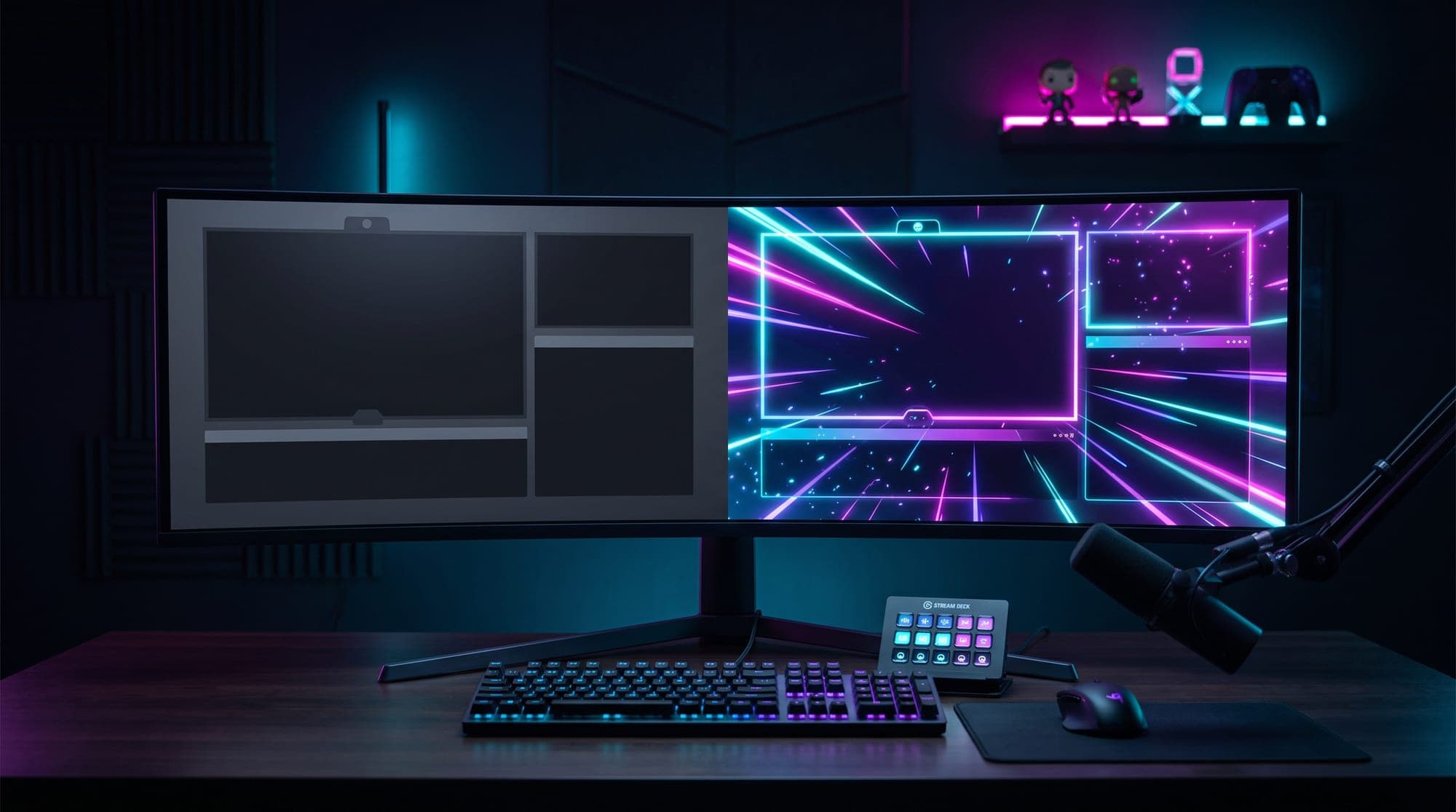
Every shop selling animated overlays tells you animation wins. Every shop selling static templates tells you static is safer. Both leave out the part that actually decides it, which is that "animated" describes two completely different things inside OBS, and only one of them costs you real performance.
So here is the version with the settings in it.
The short answer
Animate the moments, keep the furniture still. Alerts, transitions and your between-scene screens should move. Anything a viewer has to read, chat, labels, panels, should not. Then load the moving parts as video files rather than web pages, and the performance question mostly disappears.
If you take nothing else from this page, take that last sentence.
"Animated" means two very different things in OBS
This is the distinction nobody makes, and it is the whole ballgame.
A media source is just a video file
You add a WebM or MP4 through Sources, Media Source, and OBS plays it. Modern OBS hands the decoding to your GPU, so a looping animated webcam frame or a Starting Soon scene costs you a rounding error. You can run several at once on a modest machine without your encoder noticing.
This is how a proper animated overlay pack ships, and it is why "animated" and "heavy" are not synonyms.
A browser source is an entire web browser
Chat widgets, alert boxes from StreamElements or Streamlabs, follower goals, anything with a URL: each one launches a full Chromium instance inside OBS, rendering HTML, CSS and JavaScript every frame. That is genuinely expensive, and it is expensive whether the thing on screen moves or not.
Here is the part that reframes everything: a streamer running six browser-source widgets and a static PNG layout is working their CPU far harder than one running a fully animated video overlay with two widgets. The cost was never the animation. It was the browser sources.
The file format decides how much it costs
OBS can read transparency from three formats, and the one most people reach for is the worst of them.
- WebM (VP8 or VP9) with an alpha channel. The practical standard. Real per-pixel transparency, small files, hardware decoding. This is what animated alerts and webcam frames should be.
- MOV (ProRes 4444). Keeps a proper alpha channel and looks perfect, but the files are enormous. Fine as a working format while you edit, wasteful to run live.
- APNG. Full transparency, correct colours, no compression to speak of. Works, but a WebM does the same job at a fraction of the size.
- GIF. The trap. A GIF pixel is either fully visible or fully invisible, with nothing in between, and the whole file is limited to 256 colours. Put a transparent GIF over gameplay and you get jagged stair-stepped edges and visible banding in every gradient. It is the single most common reason an overlay that looked fine in a preview looks cheap on stream. If a shop is selling you animated assets as GIFs, that tells you what you need to know.
When you install a pack, the screens usually arrive as MP4 (no transparency needed, they fill the frame) and the alerts and frames as WebM (transparency required). If you have never done it, adding an overlay to OBS takes about ten minutes, and the process is nearly identical in Streamlabs and StreamElements.
Where animation earns its place
Motion is a spending decision. You have a limited budget of viewer attention, so spend it where something is actually happening.
- Alerts. A follow or a raid is an event, and events should feel like events. This is the highest-return animation on your entire layout, and we broke down what separates an alert that lands from one people tune out.
- Your Starting Soon, BRB and Ending screens. These are the only moments your viewer has nothing else to look at. A still image says the stream is broken. A slow looping scene says it is coming back. Our starting soon screen guide covers the countdown timing.
- The webcam frame, gently. A slow glow, a drifting particle, a subtle pulse at the border. It frames your face without competing with it. This is exactly the animated webcam border territory, and if you want the install steps specifically for cam sources, our OBS webcam overlay guide walks through the sizing and cropping.
- Scene transitions. A stinger covers the ugly half second where your layout rebuilds. Cheap to run, disproportionately professional.
For VTubers there is an extra rule, since the model itself is already the moving element on screen. We covered that trade-off in the VTuber overlay roundup.